What the PPSR is, and what "PPSR listed" means
PPSR stands for Personal Property Securities Register. It's one national register, run by the Australian Financial Security Authority (AFSA), where lenders record a claim over things people borrow against: cars, motorbikes, caravans, boats, machinery. It replaced the old state registers on 30 January 2012. That's why NSW buyers who grew up running a REVS check now run a PPSR check instead. Same idea, one search for the whole country (our NSW PPSR check page covers the NSW side).
When people say a car is "PPSR listed" or "has a PPSR on it", they mean a security interest is registered against its VIN. Usually that's a car loan. The lender registers it so it can take the car back if the loan isn't paid, and that right stays with the car when it's sold. Buy it from a private seller without searching and the debt can become your problem, even though you paid in full.
Is it legit? It's the Australian Government's own register. Plenty of businesses, Carify included, sell reports built on a PPSR search, and any official certificate can be checked for free with its search number (more on that below).
How to do a PPSR check, step by step
- Read the VIN off the car. It's the 17-character vehicle identification number, usually at the bottom of the windscreen (inside), in the engine bay, or on the driver's side door opening. Cars built before 1989 mostly have a chassis number instead. Don't search the VIN from the ad or one the seller texts you: one wrong character gets you a clean result for a different car. Here's how to find and read a VIN.
- Match it to the rego papers. The VIN on the car should be the VIN on the registration certificate. A number plate on its own won't work, because the PPSR can't be searched by plate or engine number. If all you have is the plate, your state's free online rego check usually shows the VIN, or a Carify search takes the plate and state and finds the VIN for you.
- Search at ppsr.gov.au. Go to the government's used car or vehicle search, enter the VIN and pay $2 by credit or debit card. Check the VIN twice before you pay. The fee isn't refunded if you mistype it.
- Read the certificate. The result opens on screen as soon as the search runs. View it, save it as a PDF or have it emailed to you; the $2 covers all of that. How to read it is further down.
- Make sure the certificate describes this car. The vehicle section lists make, model, colour, plate and engine number. Compare them with the car and the papers. If they don't match and you know you typed the VIN correctly, slow right down. The government's own guidance is that a mismatch can be a sign the VIN has been altered.
- Keep the certificate with the sale papers. It's a legal record of what the register said at the moment you searched, down to the second.
- Search again on the day you pay. The legal protection a clear search gives you only covers a search done on the day of the sale or the day before. If your first search was last weekend, spend another $2.
How much a PPSR check costs
It's $2 online. If you'd rather do it over the phone, the PPSR contact centre runs an assisted search for $7. Both fees are set by the Personal Property Securities (Fees) Determination 2018, there's no GST on them, and the certificate itself costs nothing extra.
There's no official free PPSR search. A few related things are free, though, and they're worth knowing:
- Checking a certificate someone else ran. If the seller hands you one, put its search number into the PPSR's retrieve search page and you get a copy straight from the register. It shows the result as it was on the day of that search, not today.
- A search refresh. For 14 days after a vehicle search, retrieving it again tells you whether anything has changed since: a loan registered, or one ended. It won't tell you what changed, and it doesn't update the written-off or stolen details. For those you pay for a new search.
- "Free PPSR checks" from insurers and other sites. Some insurers advertise one to bring you in for a quote. It's the same register data underneath, so check the search date and the VIN on whatever you're given.
How long it takes, and how quickly the register updates
Online, the search itself takes seconds. Most of the time goes on typing the VIN and paying. Now and then the vehicle details come back empty because the national vehicle database the PPSR pulls them from (NEVDIS, run by Austroads with data from the state road agencies and police) is unavailable at that moment. The finance result is still valid when that happens, but the PPSR doesn't refund the fee, so you may want to search again later to get the written-off and stolen details.
The finance side is current to the minute. Every certificate prints the exact time it reflects ("This search certificate reflects the data contained in the PPSR at..."), and a new search shows the register as it stands when you run it.
A paid-off loan is different. The registration stays until the lender ends it. If the seller says the loan is cleared but the certificate still shows it, the owner has to get the lender to remove the registration. If the lender won't, there's a formal route: an amendment demand sent to the address on the certificate, then, after five business days, an application to the PPSR registrar or a court. Until a new search comes back clear, treat the money as still owing.
Written-off and stolen records come from state road agencies and police, so they can lag. A car stolen this morning may not show yet. As the register itself puts it, a car not recorded as stolen isn't proof that it isn't.
Reading the certificate
A vehicle search certificate has two parts that matter: the PPSR registration details, which are about money, and the vehicle details from NEVDIS, which are about the car.
If nothing is registered, the certificate says it in one long sentence: "There is no security interest or other registration kind registered on the PPSR against the serial number in the search criteria details." That's the line you want to see.
If something is registered, you get a block like this one, from a real certificate on a car a Carify customer checked:
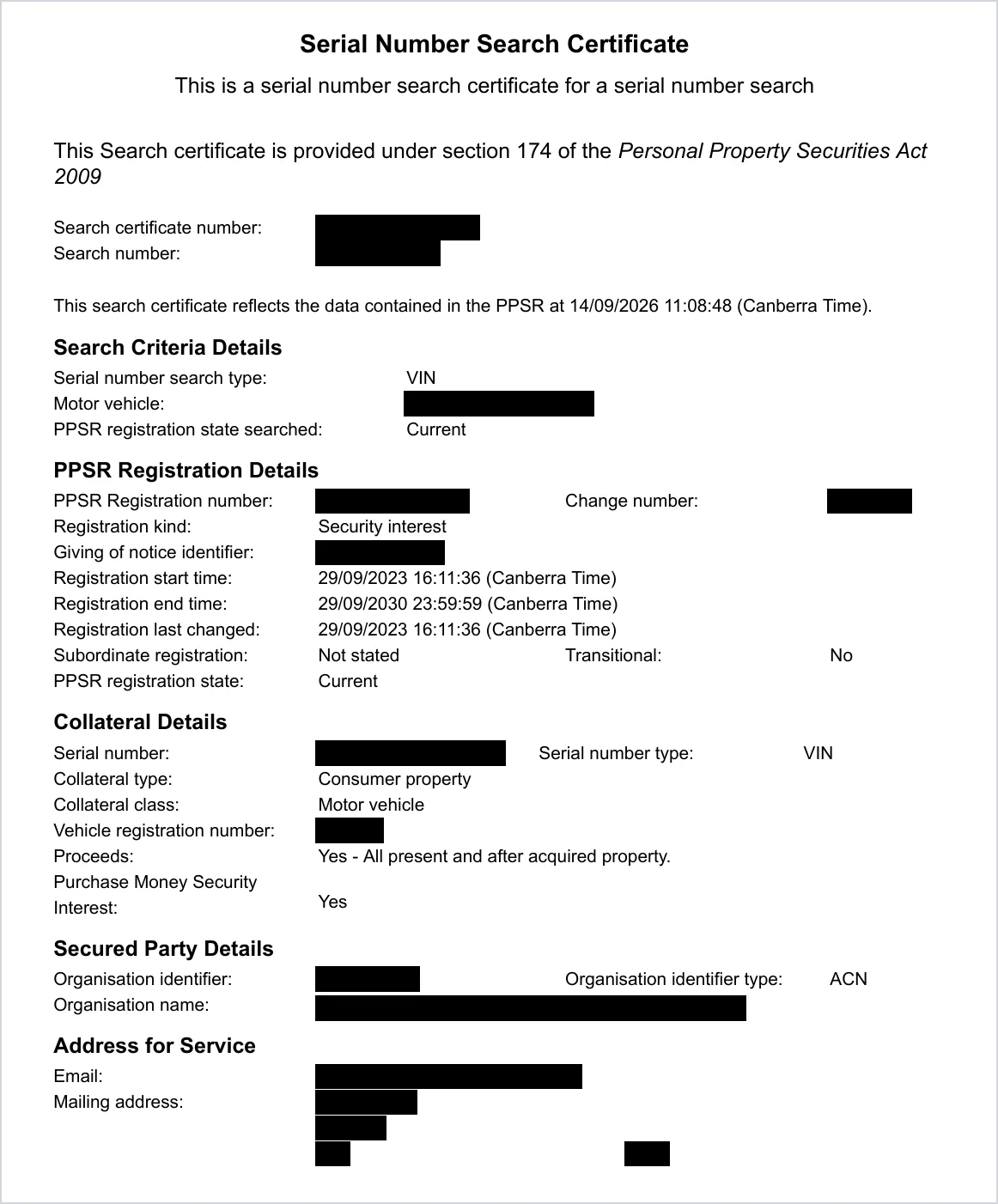
Reading it top to bottom:
- "Registration kind: Security interest" means a lender has a claim over the car.
- "Collateral type: Consumer property" means the car is held privately, not by a business.
- "Purchase Money Security Interest: Yes" means the loan was used to buy this car.
- The registration end time is when the registration lapses unless the lender extends it. It says nothing about how much is left on the loan. No PPSR certificate shows the amount owing.
- The secured party details name the lender and give its address for service. That's who the seller deals with to pay the loan out and have the registration removed.
Don't let the word "registration" trip you up. "PPSR registration" means a security interest. "Vehicle registration number" and "Registration expiry" are the ordinary road rego.
The second part, headed Additional Motor Vehicle Details (NEVDIS), describes the car and carries the written-off and stolen records. Here's the same certificate:
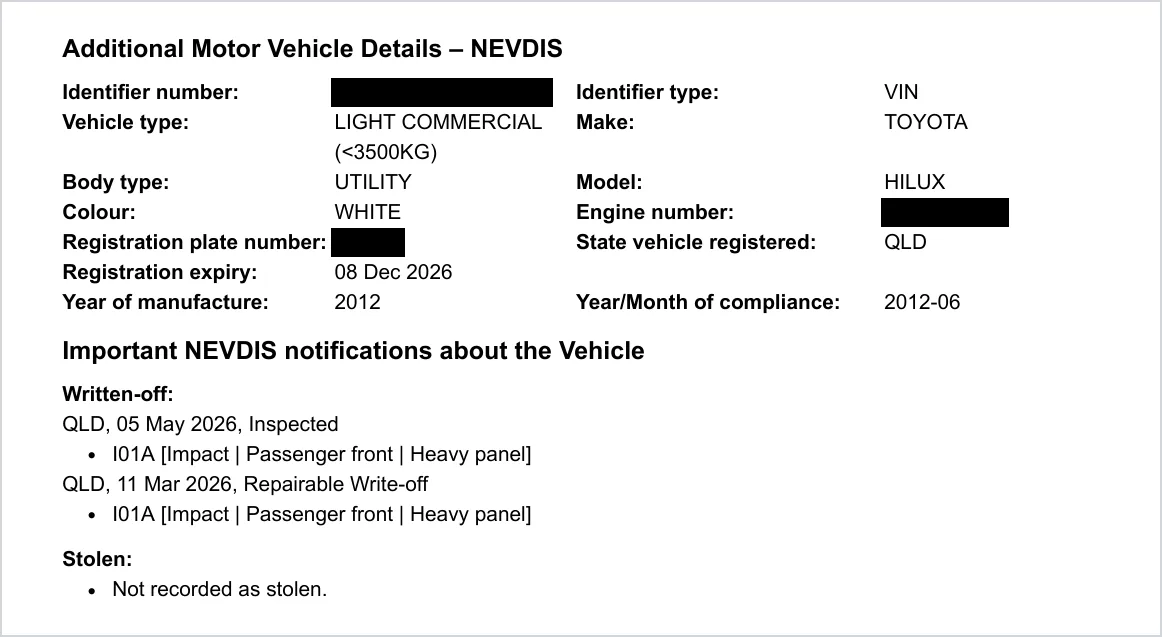
This Hilux is a good example of why the search earns its $2. It has a loan registered against it and a write-off on its record, and you'd find neither on a test drive.
The written-off entry will say one of three things:
- "Not recorded as written off", which is what you want.
- Statutory write-off. The car can never be registered again and is only fit for parts or scrap.
- Repairable write-off. Depending on the state, it can go back on the road after it's repaired and passes safety and identity inspections. The write-off stays on its record either way, which is what you see here: the "Inspected" line records that later inspection.
The code under each entry (I01A here) describes the damage: the type, where on the car, and how bad. Stolen records can be against the VIN, the plate or the engine. One gap: Tasmanian stolen data isn't included, so for a Tasmanian-registered car the certificate points you to Transport Tasmania's own lookup.
What a PPSR check won't tell you
The PPSR is about debt and legal status, not the car's life story. A certificate won't show:
- how much is owed, only that a security interest is registered
- who owns the car, or who has owned it
- the odometer reading, so it can't catch a wound-back odometer
- outstanding fines
- accidents that weren't bad enough for a write-off (here's how to check if a car has been in an accident)
- service history, open recalls or mechanical condition
Those need other checks, and for the mechanical side, a proper inspection by someone who isn't the seller.
If the certificate shows a problem
Finance owing. Talk to the seller before anything else. The clean way through is for the loan to be paid out and the lender to end the registration before you hand over your money, then a fresh search that comes back clear. A promise that "it'll be sorted after the sale" protects the seller, not you. One of our customers in NSW had exactly this: the report showed finance owing, the seller paid the loan out a few days later, and a second search confirmed it was gone before the sale went ahead.
Buying from a licensed dealer is different. You're generally protected from repossession even if a security interest was registered when you bought, unless the dealer itself is the secured party (dealer finance, for example). Plenty of people still search anyway.
A write-off. A statutory write-off is a hard no unless you're buying parts. A repairable write-off can be a fair buy at the right price, but ask for the repair and inspection paperwork, get your own inspection, and expect it to be worth less and possibly harder to insure. Our guide to statutory write-offs and your options goes further.
A stolen record. Don't buy it. Contact the police in the state shown on the certificate and quote the reference number. If a car you buy privately later turns out to be stolen, you can lose both the car and the money you paid. See our stolen vehicle check for more on what's covered.
Details that don't match. Check you searched the right VIN. If you did, treat the mismatch as a warning sign rather than a typo on the register.
What turns up in Carify's own checks
Of the cars Carify customers checked between October 2019 and July 2026, 9.9% still had money owing to a lender, secured against the car itself. That's about one in ten. Over the same period, 13.4% carried a written-off record, and 93% of those were repairable write-offs, the kind that can be back on the road and for sale. People tend to check when something feels off, so these figures run above the market as a whole. Still, that's the group you're in when you're about to buy. The full numbers are in our written-off cars data report.
The $2 search or a Carify report?
| Official $2 PPSR search | Carify PPSR report | |
|---|---|---|
| Search with | VIN or chassis number only | Rego and state, or VIN |
| Finance owing (security interests) | Yes | Yes, from the same register |
| Written-off and stolen records | Yes, where NEVDIS has them | Yes, plus pictures of recorded damage |
| Official PPSR certificate | Yes | Yes, included |
| Odometer readings from earlier records | No | Yes |
| Market valuation | No | Yes |
| Safety recalls, including Takata | No | Yes |
| After the search | Free refresh for 14 days says if the finance has changed, not what | Automatic finance updates for 14 days |
| Cost | $2 online, $7 by phone | Shown before you pay |
If the car is cheap, you've had it inspected and you have the VIN, the $2 search might be all you need. Run it. If you're spending real money, the odometer history and the damage pictures are where a report earns its keep, because those are the problems a clean PPSR certificate can't rule out. Enter the rego or VIN to get a full PPSR report, official certificate included.
Checklist before you hand over the money
- The VIN came off the car and matches the rego papers.
- The PPSR search was done today or yesterday, on that VIN.
- The certificate says no security interest is registered, or the seller's loan has been paid out and a new search shows it gone.
- It's not recorded as written off, or it's a repairable write-off and you've seen the repair and inspection paperwork and priced that in.
- It's not recorded as stolen.
- Make, model, colour, plate and engine number on the certificate match the car.
- The odometer and service history make sense, and someone independent has looked the car over.
- You've saved the certificate with a receipt and the transfer papers.
Official sources
We checked every fee and rule in this guide against these pages on 27 October 2026:
- PPSR: Do a used car or vehicle search
- PPSR: Understand your car search result
- PPSR: Are you concerned about a used car search result?
- PPSR: Get a copy of a PPSR search result
- PPSR: Fees for using the PPSR
- PPSR: How the PPSR protects buyers and lessees
- PPSR: How to dispute a PPSR registration
- Australian Financial Security Authority